
Diagnostic Command Surface
Build a closure diagnosis system your support, QA, and engineering teams can trust.
WhyDidItClose turns ambiguous app exits into a structured incident record with dominant cause, bounded confidence, and the next action to execute or hand off.
Problem to Pricing, in one deterministic flow
- Problem: app closure tickets arrive as “it closed” with minimal diagnostic context.
- Consequence: support and QA burn cycles on back-and-forth before any owner can act.
- New approach: convert closure events into cause + confidence + recommended next move.
- How it works: capture, correlate, classify, recommend, and expose uncertainty when evidence is limited.
- Proof: reviewed GO dataset with 100.0% correctness and 100.0% actionable output.
- Pricing: Pro Lifetime for operators, Team rollout for multi-seat support and QA lanes.
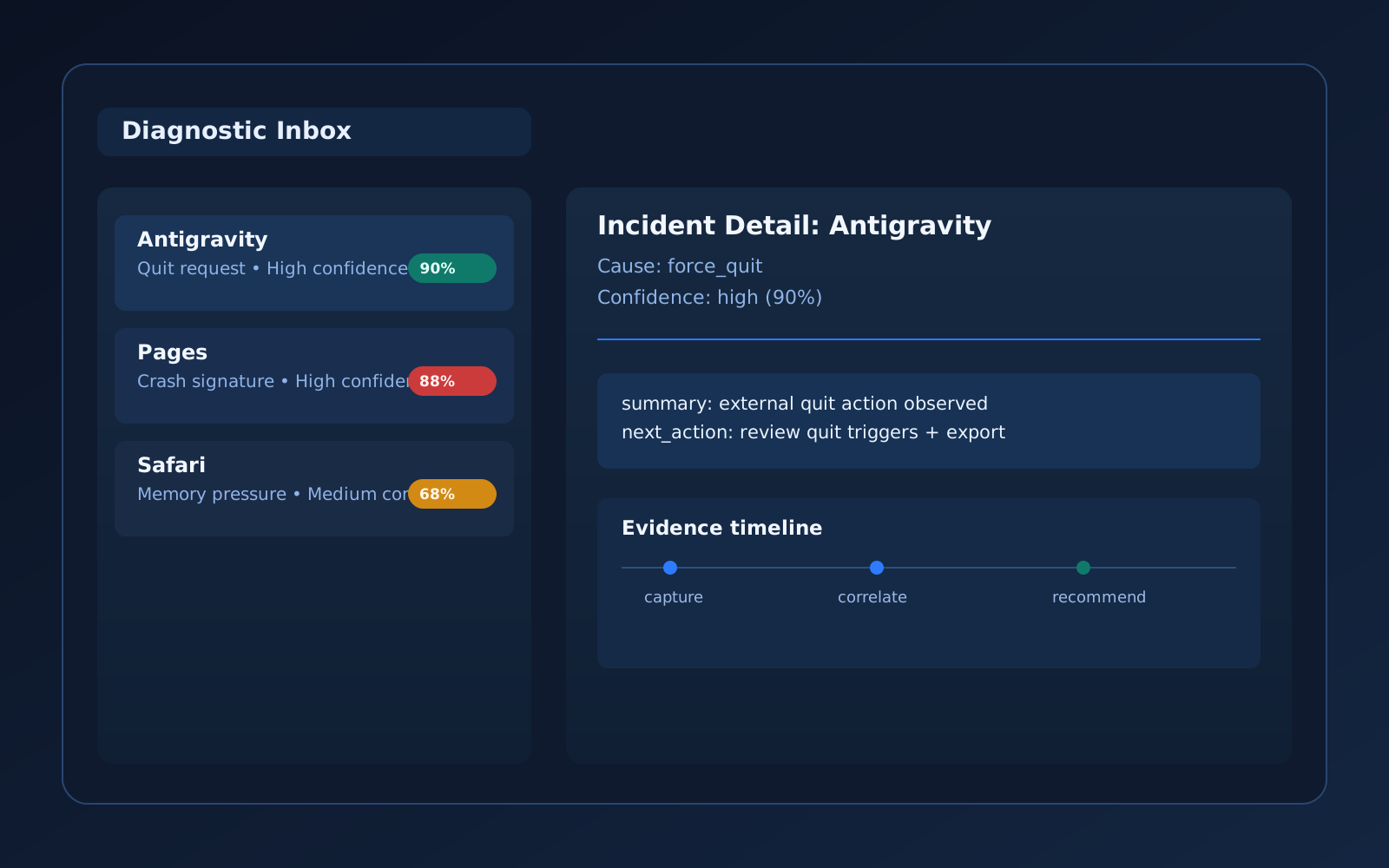


Diagnose
Convert vague closure reports into a disciplined incident brief
Every captured event becomes a structured package: what happened, why the model believes it, and what the operator should do next.
Defend
Keep data local until a human explicitly decides to export
Security posture is visible in-product: local evidence, redacted export defaults, and a published trust path for distribution verification.
Deploy
Support direct download now, App Store next, and iPhone companion workflows after
The product surface is designed for real rollout sequencing, not a one-shot launch page.
Reliability Signal
Reviewed alpha gate achieved 100.0% correct-enough and 100.0% actionable classification in the GO run.
Operational Value
WhyDidItClose keeps uncertainty explicit, so teams escalate with clearer evidence instead of assumptions.
Local-first is a product moat, not a slogan
| We collect for diagnosis | We do not collect by default |
|---|---|
| App identity, timestamps, termination metadata | Account credentials |
| Local evidence around event windows | Continuous cloud session replay |
| Optional explicit feedback actions | Full user telemetry stream |
Release System
Choose the right distribution lane for the job
Direct macOS distribution
Best for immediate install, SHA256 verification, and controlled team rollout before App Store review overhead.
- Signed + notarized zip distribution
- Published checksum and support path
- Fastest route from build to operator
Mac App Store lane
Best for consumer discovery, first-party purchase flow, and a cleaner restore story once submission packaging is locked.
- Sandbox + App Store Connect submission path
- Mac App Store provisioning and installer packaging
- Aligned with in-app purchase rollout
iPhone companion
Best for mobile review, handoff, and imported incident packs. iPhone is a companion lane, not a system-wide monitor.
- Import exported incident JSON from Mac
- Review cause, confidence, and next action on the go
- See iPhone product direction
Case Snapshot
Support triage quality
100.0% actionable across reviewed diagnostic outputs.
Case Snapshot
Cause precision gate
100.0% correct-enough with wrong-cause held at 0.0%.
Case Snapshot
Reliability volume
135 captured events validated through the alpha gate workflow.
Individual Operator
Pro Lifetime - $39 one-time
High-throughput triage and export workflow without subscription pressure.
Support + QA Teams
Team - $12/user/month
5-seat minimum with standardized handoff and rollout support.
Next Surface
WhyDidItClose for iPhone is a secure companion, not a fake parity app
iPhone cannot inspect other apps the way macOS can. The right product is a mobile incident viewer for exported packs, operator handoff, and on-the-go review.
Download, verify SHA256, and run your first diagnosis today.
Signed, notarized, and benchmarked with reviewed gate evidence.
WhyDidItClose is not another crash logger and it is not a vague observability promise. It is an operator surface for one precise question: when the app closed, what is the strongest cause we can justify and what should happen next?
The premium product story is built around proof density, deployment trust, and cleaner escalation quality.
What the premium workflow actually changes
| Workflow layer | Before | After |
|---|---|---|
| Support intake | "It closed" with no clear owner | Cause class, confidence, and handoff summary |
| QA validation | Manual log spelunking and guesswork | Evidence timeline with reproducible context |
| Engineering escalation | Missing environment and low-signal tickets | Structured export with bounded certainty |
| Security review | Trust assumptions live outside the product | Verification path, published hash, and local-first model |
Operational surfaces
- Command center for recent incidents, cause lanes, and confidence-weighted triage.
- Evidence timeline for sequence review before escalation.
- Security posture for export defaults, storage behavior, and verification.
- Distribution lane for direct download now and App Store lane when packaging is complete.
- Companion lane for iPhone review of imported incident packs.
Why the product is local-first by design
The product keeps the critical path local:
- detect the close
- correlate local evidence
- classify the likely cause
- expose confidence and caveats
- export only when the operator chooses to share
That model is stronger than generic "privacy-first" copy because it changes the default behavior of the product itself.
Product surfaces that justify premium pricing
| Surface | Why it matters |
|---|---|
| Confidence-aware diagnosis | Makes escalation urgency explicit instead of implied |
| Structured export | Turns incidents into reusable support and engineering artifacts |
| Signing + notarization + checksum | Gives direct-download trust without hand-waving |
| Security page and support policy | Removes ambiguity from rollout conversations |
| Team rollout path | Supports multi-operator workflows, not just solo usage |
Public contact path
If you are planning rollout, need procurement answers, or want the iPhone companion preview, contact support@whydiditclose.com.